YWCA’s Gender-Based Violence Specialized Services (GBVSS) Department uses a survivor-centered model to heal the harm caused by gender-based violence (i.e., domestic violence, sexual assault, and commercial sexual exploitation). We utilize a culturally relevant practice and trauma-informed care approach in all of our programs, and our advocates provide intensive, individualized services for survivors of gender-based violence, especially members of our community who are furthest from opportunity.
The Evolution of YWCA's Specialized Services
For over 20 years, YWCA's Associate Director of Legal Advocacy and Outreach Doris O’Neal has nurtured the growth of our GBVSS Department and laid the foundation for many of our programs. Originally working at the front desk of YWCA's Fifth and Seneca office, Doris found her passion for helping survivors of gender-based violence after attending a domestic violence (DV) training. Doris cites the victim panel in that training as a key moment for her; "Hearing those women talk about the abuse that they have experienced—in my heart, I was like: 'This is my calling, I want to help'."
After working at the Prosecutor's office for 18 years and working as a Victim Court Advocate for her last 8 years there, Doris became a Legal Advocate for YWCA in 2006 and later became the Director of our Gender-Based Violence Specialized Services division. In 2016, she recruited Nature Carter to manage YWCA's new Commercial Sexual Exploitation (CSE) Advocacy program, and since then, this dynamic duo has helped thousands of survivors directly and indirectly through their work with partners on the city and state level. Nature's advocacy work for policies that protect survivors of gender-based violence has led to the passing of bills like House Bill 1089, which creates state-wide funding for services that support individuals impacted by human trafficking and exploitation, making Washington the first state in the nation to pass a human trafficking law. Doris' efforts to provide more resources to survivors of gender-based violence led to the creation of Survivors FIRST, a unique program in partnership between YWCA and the King County Prosecuting Attorney that directly connect survivor-defendants to intervention services without criminal charges.
"The work is intense," Doris said while recalling her long history working with survivors of gender-based violence. "You know, many times it takes a survivor up to 7 times before she will completely leave her abusive relationship, because leaving is not that easy to do." Despite this knowledge, Doris doesn't let that statistic discourage her or her team. No matter what happens, "We'll still want our door to be open, we'll still want to hear from her, because eventually, she's gonna be more prepared and she's gonna know what her options are so that she can make the best choice for herself and her family."
Trauma-informed care and Specialized Services
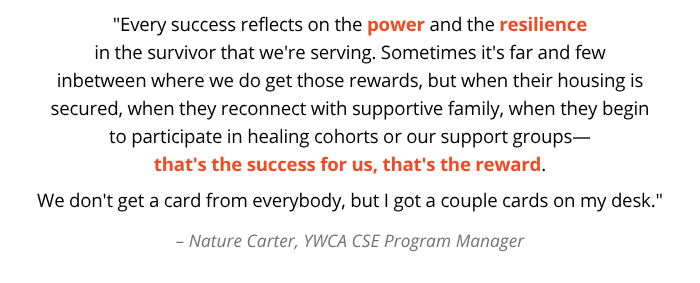
So what exactly makes YWCA's services 'specialized services'? As Nature explains it, it's because, "We specialize in addressing the intersections of violence, not just the individual acts of violence."
YWCA's GBVSS team understands that survivors experience harm in different ways, and their experiences are shaped by race, culture, gender, economic circumstances, family dynamics, access to resources, and interactions with systems that may not have been designed with their needs in mind. Our GBVSS Department's philosophy is built around survivor-centered, anti-racist, trauma-informed, and culturally responsible advocacy, and those areas of advocacy include domestic violence, sexual assault, commercial sexual exploitation, human trafficking, housing stability, legal advocacy, prevention, and therapeutic support.
Centering the unique needs of survivors is especially important for our Survivors FIRST program. "There are misconceptions about domestic violence at every level of criminal justice, from law enforcement to the courts. Because of racial bias and stereotypes of Black women, they are often seen as a threat, rather than a victim," says Doris. "Once the cuffs go on, everything changes. They may lose custody of their kids. Get turned down for housing or employment. They’re at risk of further violence. They lose their freedom and dignity."
"Supporting survivors requires more than responding to a single incident of violence," says Nature when explaining their intersectional mindset. "We must understand the whole person, the circumstances surrounding their experiences, and the systems that may have contributed to their vulnerability. That is where our specialized services begin."
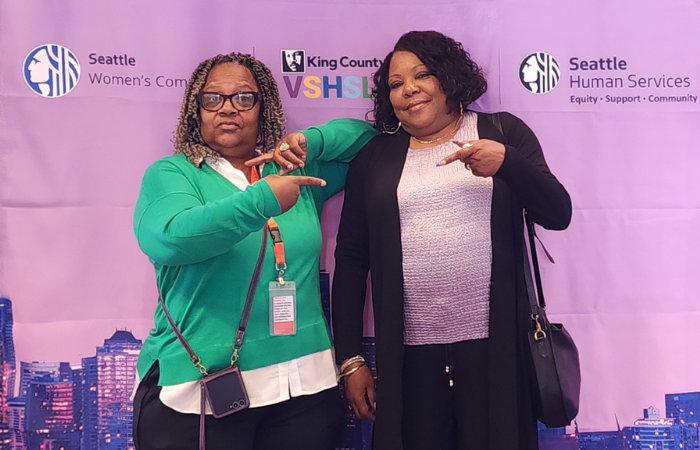
When survivors of gender-based violence come to YWCA, Doris and Nature say the most important thing is to try and make them feel welcomed and safe, to meet their needs, offer resources, and listen to what they have to say—but these resources are only available to people who reach out and ask for help. It's often difficult for survivors of gender-based violence to take that first step, out of concern for their or their family's safety or privacy, and it can be especially difficult for BIPOC women and other marginalized communities to trust organizations to help them when the system have failed them so many times before.
"When a survivor enters into our services after years of instability, exploitation, and unsafe housing, at intake, that trust is so low in systems [because of] the way that they had been treated, especially our black, brown, and non-English speaking [survivors], and also our trans population. Folks have felt harmed rather than supported, and those systems are not built on the infrastructure to work with our most marginalized communities," explains Nature. In addition to the culturally responsive advocacy and harm reduction support YWCA offers, Nature explains that the approach the GBVSS team takes is simple: it's relational rather than transactional.
What's the difference between "relational" and "transactional"? Nature says it's a matter of being there for survivors—whether that means showing up at a hotel in the middle of the night to help them get somewhere safe to sleep or taking them away from a triggering situation to sit down and have a cup of coffee or tea—it's about listening, being present, being reliable, and speaking person-to-person. "These relationships [are] based on not what was given, but the support and the care that was provided, rather than rushed timeline," says Nature. It's not about serving clients; it's about serving people. "We have to think outside the box; we have to be visionaries in the way that we deliver services. It can't just be the norm, because we need to meet folks where they're at."
YWCA's IMPACT
People have different needs depending on where they're at, and YWCA's GBVSS programs serve people from all walks of life. Our resources are set by what the overall need is for that person that's being served; sometimes that's food bags, sometimes it's gift cards, sometimes it's hair products, sometimes its hotel vouchers, but Nature says ultimately, "The services align with YWCA's mission; they're equitable, they come from a place of care, and we ensure that the quality of care and those needs can be met. That hygiene pack comes along with trauma-informed care and additional supportive services."
No matter what a person's background is, they can expect equitable, consistent, and high-quality care from YWCA.
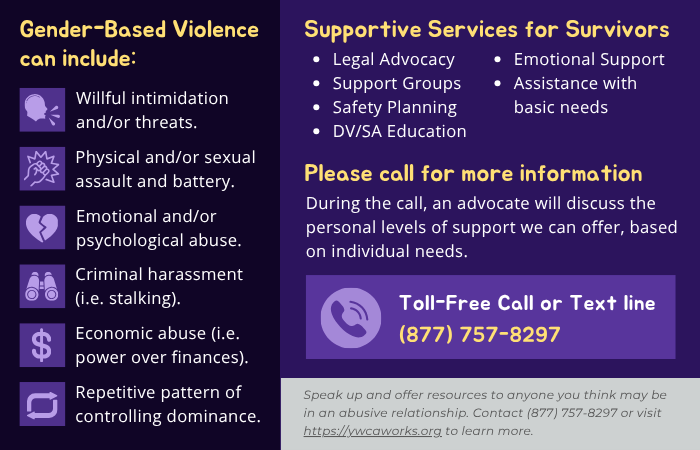
Learn more about our Gender-Based Violence Specialized Services programs, hear stories from more YWCA participants, and give YWCA your support to help us continue our fight to end gender-based violence.

Ana Rodriguez-Knutsen is the Content Specialist for YWCA's Marketing & Communications team. From fiction writing to advocacy, Ana works with an intersectional mindset to uplift and amplify the voices of underrepresented communities.
We share the stories of our program participants, programs, and staff, as well as news about the agency and what’s happening in our King and Snohomish community.
