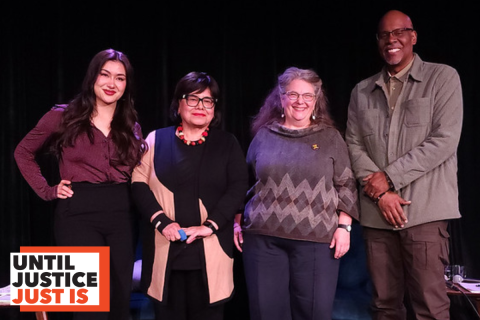
Last month we held the 15th annual YWCA Seattle | King | Snohomish's annual Until Justice Just Is (UJJI) event, which is part of a national YWCA movement to raise awareness about the impacts of racism and build community among those working for racial justice. The conversations we have and the resources we share foster personal reflection, encourage social responsibility, and motivate participants to identify and act on ways to dismantle racism and other forms of discrimination.
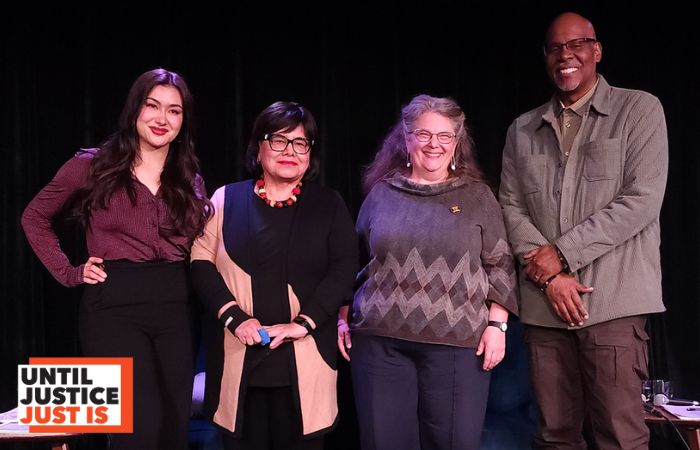
This year's theme was Housing Justice: From Policy to Practice. Our panel discussion, led by YWCA Chief Public Policy Officer Margaret Duñgo Gritten, focused on the ways housing policies show up in the day-to-day lives of people in our community and how we're addressing barriers to housing for women, families, and communities of color. Panelists Estela Ortega (El Centro de la Raza), Alison Eisinger (Seattle / King County Coalition on Homelessness), and Gregory Davis (Rainier Beach Action Coalition) weighed in and shared their perspective as community leaders, advocates, and service providers as we discussed what's working, what's not, and the changes needed to ensure safe, stable, and affordable housing for all people across King and Snohomish Counties.
What Works and What Doesn't
There are many issues with our current housing system, but something our panelists agree on is that community and collaboration, especially between organizations like YWCA and the Seattle / King County Coalition on Homelessness, has positive results. "Our community collectively is providing stable, quality shelter and homes for thousands and thousands of people every day and every night," said Alison, though she emphasizes that even with this success, there are still tens of thousands of people who cannot be accommodated by our existing systems.
![“Uplifting the power and voices of women and girls and directly confronting racism [are] two essential elements if we are going to make progress in housing justice. The deep inequities that exist in our nation—in our political and economic and social systems—are tied to deep inequities around race, around gender, and of course, around class.” Alison Eisinger, Seattle / King County Coalition on Homelessness](/sites/default/files/inline-images/2026%20YWCA%20Blog%20Post%20Graphics%2848%29.png)
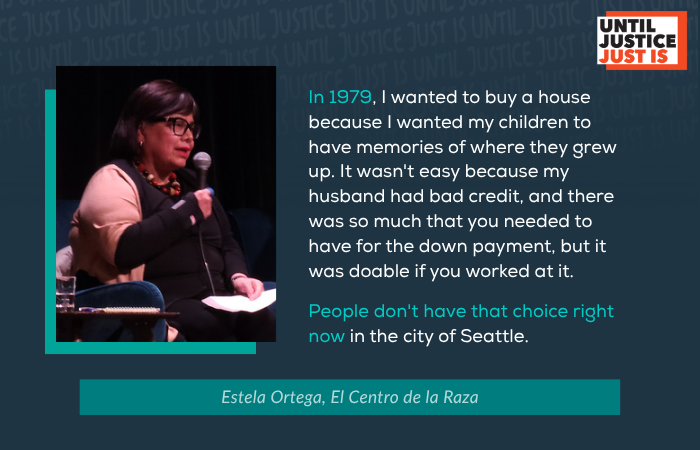
Although there is still a lot of work ahead of us, Estela believes that by working together with allies, we can make it happen. How do community-based organizations develop assets? Estela said it sometimes requires partnership with other entities that have been doing housing development for a long time. "Housing development is not easy; you need someone by your side who knows how to handle those situations when they come up."
As the conversation moved to the topic of race and identity, our panelists discussed how people's identities intersect with housing access and housing needs. For example, certain barriers and safety concerns make it especially difficult for trans people in shelters, and systemic racism and historically discriminatory practices have disproportionately impacted BIPOC individuals and families (particularly Black and Indigenous people, who face some of the highest rates of homelessness.
BIPOC individuals and families who seek homes, whether through shelters, affordable housing, or otherwise, experience additional levels of mental anguish trying to navigate the process, and Gregory says it's because the process often fails them. "If they're not supported, they don't pursue it again. If the system prevents them from being successful, they then withdraw." These statistics, and various others, reflect ongoing issues like racism, sexism, and classism, and all systemic causes must be challenged and changed for us to achieve true equity and housing justice.
Change Requires Accountability
Accountability is necessary to ensure that housing policies deliver equitable outcomes, and Gregory believes that accountability on one level often informs accountability on another. "When you start at the state, it winds up holding, in some respects, counties and municipalities accountable," he said, referencing the Covenant Homeownership Act (passed by the Washington State Legislature in 2023), which helps people who have been impacted by state-sanctioned housing-based racial discrimination become homeowners. "Accountability is needed in order for vulnerable families to have opportunities."
![We do know that there's limits to centralization, but for someone [with an interest in housing or home ownership] to just have a phone number or a QR code to call and someone pick up that phone and get them connected to resources and walk them through that particular process — that's one of the things we are looking at as a best practice. Gregory Davis, Rainier Beach Action Coalition](/sites/default/files/inline-images/2026%20YWCA%20Blog%20Post%20Graphics%2854%29.png)
On the topic of accountability, Alison cited House Bill 2266, which aims to hold local jurisdictions accountable to Washington's Growth Management Act; an act that calls for communities to plan to create enough homes for all residents over the next few decades. Poor and unhoused individuals are still widely discriminated against in terms of what kinds of housing and short-term stay shelters are being approved, so House Bill 2266 is part of an accountability measure to try and resolve that. "We have a mutual accountability in the form of a social contract to make sure that we don't leave people outside."
But to do anything on the city, county, or state level, you need money. "We need more money in our city government and in our county government to develop housing," said Estela. "We need city government and county government to allocate more money. We have some, but more is needed." Estela said one way to do that is through the Millionaire Tax, which was signed into law by Governor Ferguson at the end of March. Although our speakers argue the tax is a concrete way to get more money not only for affordable housing, but also for education, health care, and many other beneficial things, it is currently being challenged in court.
What Individuals Can Do
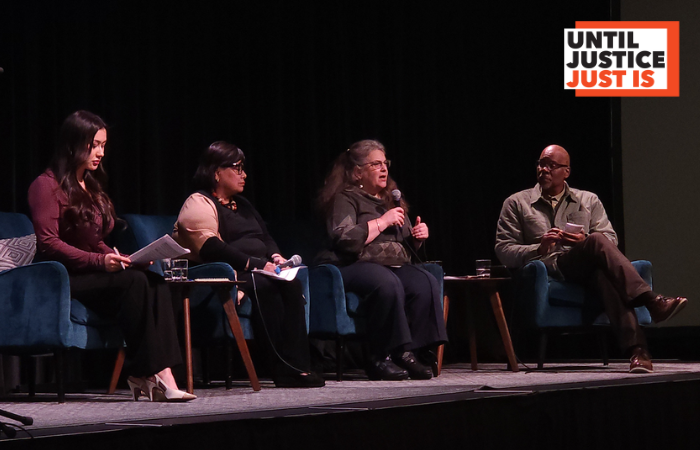
There are a lot of policies to pay attention to, and sometimes, it can feel a bit overwhelming. We asked our speakers to suggest some concrete ways people can support housing justice efforts, and the answers were: staying informed, connecting with your community, and voting.
- Get out and vote, and encourage other people. Panelists agreed that we want people in office who can help us build stronger communities, so make sure you're registered to vote, know your rights as a voter, and check your voter status!
- Support the Millionaires Tax, stay informed about the facts, and help educate others.
- Pay attention to is the Save America Act, a voter suppression bill that would block millions of eligible American citizens from voting and reverse decades of progress.
- Get to know your neighbors, because you need your neighbors to have your back, and they need to know you have theirs.
- Stay informed: attending advocacy events, subscribing to newsletters with key policy updates, or joining nonprofits, coalitions, and/or impact networks that support the same causes you do are all great options.
Watch a recording of our 2026 Until Justice Just Is event, check out our housing justice resource list, and sign up for YWCA's monthly newsletter to stay updated on future events and ways to engage in and support YWCA's anti-racism work.

Ana Rodriguez-Knutsen is the Content Specialist for YWCA's Marketing & Communications team. From fiction writing to advocacy, Ana works with an intersectional mindset to uplift and amplify the voices of underrepresented communities.
We share the stories of our program participants, programs, and staff, as well as news about the agency and what’s happening in our King and Snohomish community.
